Founding the Crown Heights Care Collective
About Me
I co-founded the Crown Heights Care Collective in April 2022, four months before I moved out of New York.
I wanted to know if I could create something that held a spark so hot + contagious that others would be able to carry it for years. I am proud that I did.
When we first started the Crown Heights Care Collective, we canvassed at Franklin Ave and Utica Ave, two Black and migrant-majority transit hubs. We were trying to understand how our neighbors experienced NYPD violence and what real alternatives might look like. The conversations were honest and complicated. Older Black New Yorkers told us directly that they didn’t trust “abolition.” One woman said: “Oh, no, we need the police.”
Many of the white organizers with the Crown Heights Care Collective believed in police abolition for theoretical reasons. To make it make sense to real black New Yorkers, we needed to make alternatives to policing look not just realistic, but enticing. A similar abolitionist organizing effort in 2022 by DSA members in Bushwick struggled to take shape without the strong built-in community ties we had with Crown Heights Tenant Union and Crown Heights Mutual Aid.
What made the Crown Heights Care Collective work was that we created a container that believably fit within the existing ecosystem of the neighborhood.
I came up with the name “Crown Heights C.A.R.E. Collective” — I thought it evoked the same spirit as S.N.C.C. I chose our logo, designed our flyers, and curated our social media presence. I organized two retreats over Summer 2022. I pushed us to take creative and experimental risks in our programming (distributing water guns and school supplies in a public park, etc). I encouraged us to get involved with on-the-ground crisis support as well as safety planning for protests. I invested in storytelling and dynamic photography in order to make the work feel irresistible from the outside.
I pushed a shift: toward storytelling, toward hyperlocal organizing, toward relationship-building in Crown Heights.
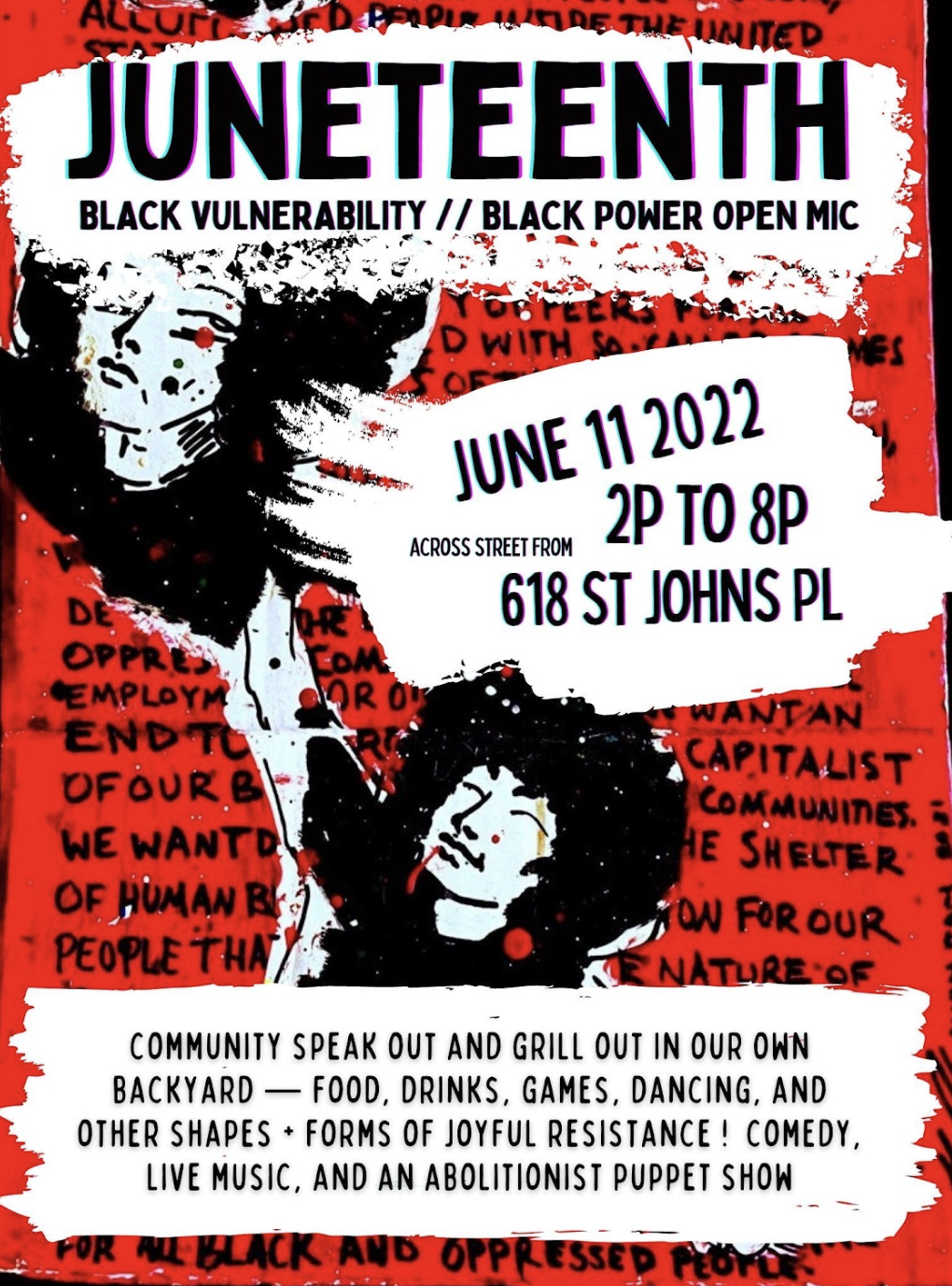
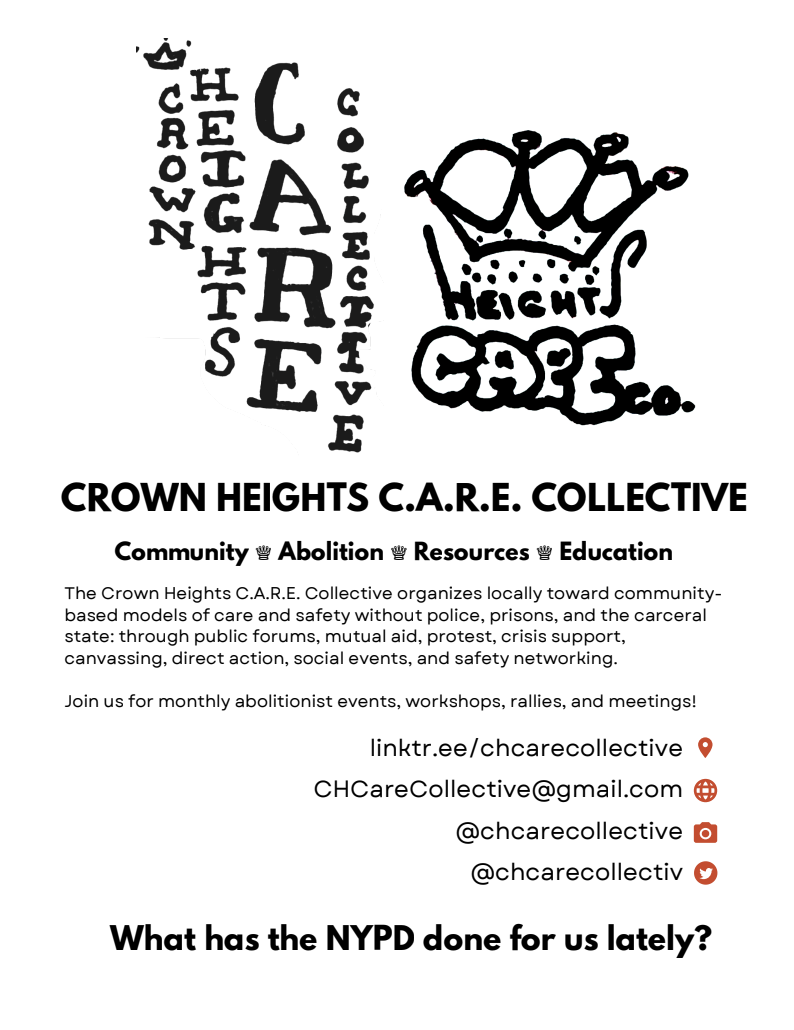
General Flyer and for our first public Juneteenth event. Designed by Amadi Ozier for the Crown Heights Care Collective.
About the Statement
I wrote the first draft of the Crown Heights Care Collective’s Statement of Core Values after re-reading Revolutionary Suicide by Huey P. Newton. Like me, Newton wrote the Black Panther Party’s Ten-Point Program in an afternoon.
I wanted it to sound black and revolutionary. (A white DSA organizer kept fighting to have all references to race removed from the document.) I wanted the document to feel both disciplined and nourishing. I wanted it to flow, to breathe, like music, like water.
Then, I moved out of town.
The organization spent the next few months smoothing out the statement at collective meetings by asking themselves thoughtful questions about what an abolitionist group is supposed to believe and accomplish.
Still, the final version of the statement looks very much like that first draft and still carries all the poetry and the spark.
Statement of Core Values
Crown Heights C. A. R. E. Collective
We are a hyperlocal abolitionist organizing collective based in Crown Heights, the unceded home of the Lenape peoples. We organize where we live; our members are primarily our neighbors. As abolitionists, we oppose slavery in all of its present-day forms. We work toward the liberation of Black and Brown people and all those who struggle against a carceral culture of surveillance and criminalization for control of our labor and wages. We do not work with cops or other agents of carceral-colonial violence and organized abandonment.
Prisons and police uphold capitalism. Their violence enforces economic and environmental conditions that disproportionately exploit and dispose of black, indigenous, brown, poor, elder, queer, migrant, disabled and otherwise marginalized people. As a historically Black, Brown, and Jewish working-class neighborhood in a gentrifying city, Crown Heights has been a target for criminalization, racialized dispossession, and municipal disinvestment. Why should the communities with the heaviest police presence receive the fewest public resources? We reject this state violence by fighting for community control over housing, healthcare, schools, food, green space, transportation, culture, and other public goods in New York City. Drawing on our neighborhood’s history of resource-sharing and crisis response, we organize toward community-based models of care and safety that do not include police, prisons, and the surveillance state. We have been bamboozled into believing these carceral systems to be necessary and inevitable; they are neither.
Real-world alternatives to police and prisons grow from loving, hyperlocal networks of mutual aid, self-defense, empowerment, and accountability. We must learn to discern and express our own needs, and by doing so understand and meet our needs collectively. We prioritize health, mental health, safety and wellbeing through networks of ongoing and responsive support. Community care is plural, mutual, adaptive, and involves acknowledging and acting from our interdependence by creating deep, lasting connections with our neighbors. Abolition demands the transformation of social relationships to create a network of neighbors who know and care for one another.
We understand that revolution requires focus, resolve, self-education, direct communication, and shared risk, and depends on channeling revolutionary spirit into vibrant, positive action. We therefore refine our analysis by creating varied spaces for community conversation, then apply that knowledge to our personal lives and political environment. We build the world we envision from the ground up through public forums and workshops, mutual aid, protest, crisis support, canvassing and tabling, direct action, social events, and safety networking. We experiment, evolve, and adapt.
We are a vibes-forward organization. We follow the rhythms of our universe, our neighborhood, our own individual bodies. We share space and time for all community members to feel heard and to feel safe asking for what they need. We embrace challenge and discomfort as foundational to our abolitionist principles, but reject combativeness for combat’s sake.
Abolition is creative, imaginative, loving. We believe that capitalism and white supremacy will fall, and we commit ourselves to the long fight to build the liberatory practices, institutions, and consciousness that will replace them.
